Pearson Partners International

Tag: interview

  • Surviving a Job Loss

    Surviving a Job Loss

    photo of Lisa Thompson, Pearson Partners VP and Professional Career CoachThe COVID-19 crisis has taken a drastic toll on the U.S. workforce, with over 20 million people suddenly unemployed and an overall 15% unemployment rate. While the economy slowly attempts to recover, more downsizings and furloughs are expected. If you are one of the ones who has lost your job, you may find yourself struggling with a variety of emotions. But this time can be an opportunity for growth, change and a better career ahead.

    Difficult Emotions Are Normal

    If you are troubled or confused about the emotions you are experiencing, take comfort in knowing that you are not alone. Job loss can be an emotionally difficult and confusing time. Feeling uncertain about the future, you may experience emotions such as anger, fear, sadness and self-doubt, while alternately experiencing relief, numbness or optimism. Tumultuous emotions are often experienced with intensity and may leave you feeling drained and unable to adequately control your moods or your thought processes. It is understandable and common to feel these strong emotions, especially in the beginning. Acknowledge them, and then try to refocus your efforts on next steps.

    The Roller Coaster Will Stabilize

    Numerous studies have shown that to varying degrees, and for varying durations, nearly everyone who experiences a job loss goes through a kind of emotional roller coaster. Keep in mind that while riding a roller coaster consists of abrupt ups and downs, in the end, the ride returns to a safe and level place. Use this time to focus on enhancing your skills (personal and professional), building your network and finding your next job, and you will most likely be in a better place when this time is behind you.

    Redefine Your Identity

    Often, we define ourselves in terms of our career, where we work and what we do. In fact, much of our sense of self-identity and self-worth is tied to our jobs, as evidenced by the common inquiry when you meet someone new: “What do you do?” Because our careers make up such a big part of our lives, it is understandable that we experience a wide range of emotions when faced with job loss. Knowing that what you are feeling and experiencing is common can help you to compartmentalize your emotions and focus on your plan of action.

    Build a New Routine

    When you are in a career transition, an aspect of your self-identity can be abruptly impacted, and simultaneously, you may feel the absence of your co-workers and friends. You may find that the routine built around your job is now gone, along with the sense of security the routine provided. It is important to build new routines to replace those of your old job. Reach out to your family, friends and network for support and encouragement. Try to pursue activities that you enjoy that you may not have had time for previously.

    Take Advantage of This Opportunity

    To gain some perspective and a frame of reference for where you are right now, and how best to move forward, consider the following tips:

    You are not alone.

    Help is available. There are family, friends and others who are able and eager to help you: all you have to do is ask. Their genuine concern is for you as a person. It is you, not your former title, that they care about. If you need more support, consider contacting a professional career counselor or a therapist to help you through this time.

    You are unique, special and employable.

    With or without a job, you are still you. Your personality, values, experiences, accomplishments, and skills are uniquely your own. The core of your personhood has not changed, only the temporary circumstances of your employment. You will bring the same qualities to your next position that you brought to your previous positions.

    Others have been, are, and will be in the same situation.

    In the recent COVID-19 crisis, reorganizations, takeovers and economic conditions have put millions of successful, talented, quality people out of work, from CEOs to entry-level employees. More often than not, job loss is unrelated to job performance.

    Your attitude is your single most important asset in your successful job search.

    A positive attitude is a requirement for success, and a negative attitude is self-defeating. Since others can readily perceive what you project, it is important to project a positive attitude and image. Take care of yourself through exercise, relaxation, social activities and other pursuits that nurture positive feelings.

    Make the best of this opportunity.

    Use this time to assess, analyze and decide what kind of job you really want and then go get it. Understand what is important in your job and your life. Balance dreams and reality while focusing on legitimate positions that meet your needs and skills. This is an opportunity for personal and professional growth.

    Getting the right new job requires total commitment.

    Finding a job is often harder work than holding a job. You must be completely engaged and employed in the full-time process of finding the right next job. Plan on a minimum of 40-hour work weeks devoted to your job search. Prepare for tough demands on your time, energy and emotions, since your total commitment is required. However, be gentle with yourself and balance the hard work with exercise and activities that you enjoy.

    Now is the time for you to assess your career and life, establish goals for your job, determine your compensation requirements and decide where you want to live. Through hard work, you can seize the opportunities that exist. Meaningful lessons are gained in overcoming adversity. While you did not volunteer for this experience, you can learn and benefit from it and find yourself in a better place when you get through it.

  • 10 Tips to Win the Job

    10 Tips to Win the Job

    photo of Lisa Thompson, Pearson Partners VP and Professional Career Coach

    Lisa Thompson, LPC, PCC – Vice President & Professional Career Coach, Pearson Partners International

    Searching for your next job may be the hardest job you will ever have, and hopefully one of the shortest. The success of your job search depends on the amount of effort you expend as well as the quality of your actions. If you are launching a new job search, it can seem like a daunting task to manage your time correctly to reap the highest impact and results.

    An effective job search campaign should be treated as a full-time job. If you are unemployed, then the 40 hours or so you’d normally spend working each week should be devoted to your job search. It is easy to slip into a pattern of spending the day on other activities and minimizing the time devoted to finding a new opportunity. A good rule of thumb is to follow the 80/20 approach: Spend 80% of your available job search time on high-impact activities and the remaining 20% on lower-impact activities.

    Lower-impact job search activities include reading job postings, applying to posted positions and connecting with executive search professionals. Higher-impact activities include networking and reaching out directly to leads and potential employers. The effective jobseeker spends a significant portion of their time talking and meeting with network contacts, attending networking events, using social media connections, identifying target companies and finding referrals through their network. Successful job seekers set up a plan of action to make the most of each day.

    As a professional career coach, I am often asked what makes the difference between winning the job and being an “also-interviewed.” Over the years, I have given plenty of thought to this question as I have coached hundreds of senior-level executives making career transitions. Here are 10 tips that I use in my coaching engagements for how to win the job.

    Tip #1: Research thoroughly.

    Research makes a world of difference in preparing you with knowledge of the company, its challenges and opportunities, the interviewer(s), the competitive landscape and even the company culture. The level of research and depth of intelligence should go beyond reviewing the company’s website. Read reports, news, press releases, bios and social media commentary on the company—not just official company posts but also those of its employees, clients and competitors. Research on interviewers helps you prepare for the types of questions that may be asked and to connect with points uncovered in bios and profiles. Connections to the interviewer can include schools, community involvement, former jobs and companies as well as geographic similarities.

    Tip #2: Practice, practice, practice.

    Practicing for an interview is a rehearsal for the real thing. It is time well spent going over your elevator speech and preparing for potential interview questions. Consider practicing in front of a mirror or better yet, filming yourself. I have never heard any of my coaching clients say that they regretted the time spent practicing for an interview. In fact, most have felt it gave them the winning edge because they thought through their answers in advance, they knew what they wanted to convey with their responses and felt well-rehearsed and relaxed during their interviews.

    Tip #3: The interview is always in progress.

    Often, the interviewer will give the impression that the meeting will be casual or just a discussion. Never forget that you are being judged and evaluated throughout all encounters. Even if the interview is a friendly conversation over a burger and fries, it is still an interview and needs to be treated as an important opportunity to make a professional impression.

    Tip #4: Get the chemistry right.

    Chemistry makes the first impression in any interview. Decisions made about candidates in the first few minutes are not likely to change. Being able to read the interviewer’s body language and quickly adapt is a critical skill. If you are genuine and likable, you will often be given a pass for a small gaffe, or at least the benefit of the doubt in other areas. If you passed the resume screening stage, then presumably you are technically qualified and the importance of personality, style and cultural fit takes over.

    Tip #5: Show enthusiasm.

    Enthusiasm is a vital tactic for getting the job. Companies are interested in candidates who are interested in them. If you are too analytical or coy in the interview process, you will likely be perceived as indifferent or not worth pursuing. Remember that you cannot accept or decline an offer you have not yet received.

    Tip #6: Highlight your best career achievements.

    Highlighting your best plays can help you win the next interview and even the job. Be prepared with narratives that demonstrate what you have achieved in your career. Carefully review the job description and thoroughly research the company, its challenges and opportunities and the interviewer(s), if possible, to make sure you can provide examples of your work with quantifiable metrics to back up your results for the key areas listed in both the job description and your resume.

    Tip #7: Demonstrate your value proposition.

    Demonstrating your career accomplishments as they relate to the job, the company and the interviewer(s) will differentiate you as a candidate. Look for the company’s points of pain and connect how you can put your experience and expertise to work right away to make a difference. For example, if the company is looking to expand, change direction or enter a new geographical market, make sure you are crystal clear on how you can help achieve this goal.

    Tip #8: Be prepared to address weaknesses.

    Consider your weaknesses that you anticipate based on the job spec, interview or research. If you know you are not a perfect fit or that that an area of concern might surface in an interview, don’t wait for the interviewer to bring it up. Make sure you are prepared to address any area of perceived weakness with a strong response. If you walk away with unanswered questions, you will probably not have another chance to redirect or correct the impression.

    Tip #9: Ask for the job.

    Before leaving the interview, make it clear that you are intrigued by the job and would welcome the opportunity. Let them know you are receptive to an offer and ask if they have any questions or concerns about your candidacy. This also gives you a chance to address any weaknesses or misperceptions before they have a chance to take root.

    Tip #10: Follow up.

    Following up after the interview with a note or email to thank the interviewer(s) provides another opportunity to highlight your strengths as they relate to the job and to show enthusiasm for the position. Make sure you have a clear understanding of the next steps and timeline for filling the position and ask if it is okay for you to check back with them within the agreed upon time. Stay in touch with the key decision makers through sharing information, articles, quick emails or calls related to things they shared in the interview. Always ask if it is okay to follow up and get a feel for their appetite for contact. I have often heard of candidates winning the job because of their persistent and thoughtful follow-up.

    It is a tough job market out there, but a well-prepared candidate stands out. Approach each job opportunity with the same energy and enthusiasm that you would give your full-time job. After all, remember that while you are in transition, your job search is your job.


  • Age as an Asset in Your Job Search

    Age as an Asset in Your Job Search

    Lisa Thompson, LPC, PCC – Vice President & Professional Career Coach, Pearson Partners International

    photo of Lisa Thompson, Pearson Partners VP and Professional Career CoachNow more than ever, people are entering the job market with concerns about finding a job that fits their level of experience (and in some cases, any job). Often, executives over the age of 50 can find themselves competing for positions with candidates 10 to 15 years younger. It is not uncommon for senior-level executives with highly successful career histories to learn that they lost the job to someone less experienced and younger.

    Most often, senior executives lose out because they have not presented their age and experience as assets to the hiring organization. Keep these tips in mind and you can use your age to your advantage in a job search.

    Demonstrate relevant experience and expertise.

    When competing for a position, you need to thoroughly research the company and approach the interview with a well-developed value proposition, including specific and measurable ways you can make a difference immediately. The experience factor is an asset that can help you ace the interview if you show that you understand the company’s strategic needs and can give valid examples of how you have handled similar situations.

    Don’t advertise your age too early.

    Your resume can affect how employers and recruiters perceive your age. If your resume shows that have over 30 years of experience and graduated from college in the 1970s or 1980s, it is not difficult to do the math. Your age will be revealed in the recruiting process, but you can help avoid being dismissed in the first pass by not including every job you have had since high school. Limit job history on your resume to the last 10 to 15 years to show recent roles and skills, and omit dates on your education and certifications. You can provide those details later after you have had the chance to show your experience, expertise and value proposition.

    Avoid using a one-size-fits-all resume.

    Read each job description carefully to make sure you show experience and expertise relevant to the position. Highlight your career accomplishments with quantifiable metrics. The way you quantify your achievements will vary for different positions—you should emphasize different metrics for a sales role than for one in marketing or technology.

    Show that you are an intergenerational team player.

    Whether in an interview or on the job, promote your ability to be a team player and to take direction or learn from a younger colleague. While older executives have much to offer in the way of experience and maturity, younger generations also have much to teach. Think of mentoring as a two-way street with collaboration as the intersection.

    Dispel the myth that older executives are not tech-savvy.

    Show your capability by understanding the technology and tools needed for each role and using relevant language. Make sure you have updated your social media, including a professional headshot. Brush up on skills to use video apps, especially for virtual interviews. If necessary, take some online classes to sharpen your technology skills and to make sure you are using the correct tools. Work on certifications or training to show you are staying current and continuing to learn and grow.

    Leverage advocates in your network.

    Working your professional network is critical to making a personal connection with a targeted company or hiring manager. Leverage your network connections to find someone that can help you reach the right people. Having an advocate that can validate your talent and abilities gives you a significant advantage over other candidates, regardless of age. As the saying goes, “It’s not always what you know, but whom you know.” This is yet another area where age is an asset: The longer someone has been in the workforce, the larger that network is likely to be.

    Above all, keep a positive attitude in your job search. If you are persistent and keep working the process, you will find the right opportunity. The person that wins the job is the one that goes into the interview with the confidence that comes from experience and the energy that comes from knowing their passion.

  • 10 Tips for Working with Executive Recruiters

    10 Tips for Working with Executive Recruiters

    Lisa Thompson, LPC, PCC – Vice President & Professional Career Coach, Pearson Partners International

    photo of Lisa Thompson, Pearson Partners VP and Professional Career CoachAs an executive recruiter, I receive frequent inquiries from people in a career transition asking how they can best work with recruiting firms. Whether you are gainfully employed and looking to make a career change or have found yourself in the position of looking for a new job, it can be a confusing and frightening time without a lot of clarity on where to start or a good understanding of the ins and outs of  the recruiting business.

    Having worked in the executive recruiting industry for over 15 years as both a recruiter and a professional executive coach, I will share 10 proven tips with you on how executive recruiters work and how to put your best foot forward when approached by one.

    Tip 1: There are two types of executive recruiting firms: retained and contingent.

    Retained search firms operate like other professional services firms such as law firms, accounting firms and consulting firms in that they work on behalf of their clients to fill specific positions and are paid on a retainer basis to conduct the search assignments. Retained firms work at the upper end of the market (typically for positions with salaries above $200,000) on an exclusive basis, and their professional fees are based on the first year’s total cash compensation for the given position. While they may be kept on retainer by the same client to fill other assignments, only one retainer firm is hired by a client company for a particular position. While your file is being used by a retained recruiter for an assignment, no other recruiter at that firm should contact you as a potential candidate for another assignment. Retained recruiters conduct research to identify, interview and assemble a short, targeted list of candidates to present to their client for the position and then work closely with the client through the process of narrowing the list, interviewing, final hire and sometimes coaching and development. Retained search firms define an “off-limits” guarantee with their clients: If the company you work for has been a client of the search firm during the past year, its employees—including you—could be off-limits for any other position the search firm may have for one year, no matter how well qualified you are. If you are at a senior executive level and are actively employed but wishing to make a change, retained recruiters are often the best choice with whom to maintain a relationship.

    Contingency recruiters are more often used for junior and mid-level executives, typically for positions with salaries below $100,000. They receive payment at the end of the process, contingent upon their potential candidate being hired. They do not usually work on an exclusive basis with their clients and other contingency firms may be working on the same search. They work fast and submit as many candidates as they can (who are generally looking for a job) with the goal to have their candidate(s) hired first. Contingency firms are often paid a percentage of the base compensation and work on volume and speed. They do not typically maintain an active engagement with the candidates or client throughout the interviewing and hiring process. If you want to send your resume to as many recruiters as possible, in the hopes that they can help you to find a job, a contingency recruiter is often your best choice.

    Tip 2: Retained recruiters work for their client companies.

    Every recruiter in the industry receives at least a dozen calls and many more unsolicited resumes a week. Job seekers often ask if the recruiter can represent them to clients to help them find a job. What they may not realize is that retained recruiters are consultants who work on behalf of their client companies to fill specific positions. Although search firms will work closely with each of the candidates for a search along the way, they are not working for you. Recruiters may contact you if they have a position that fits your profile or to ask you to recommend other people who might be interested in the job, but they do not represent you in the way an agent would an actor or an author.

    Tip 3: Recruiting is a sales-driven business.

    Recruiters sell employers on their capability to fill specific jobs, candidates on the benefits of the job and employers on the firm’s recommended candidates. Position yourself as an attractive candidate by being flexible and open to opportunities the recruiter presents in terms of not only compensation and job title but also geography. The recruiter can help you by sharing information about the employer’s hiring needs and strategic direction. If you are not the right fit for the opportunity, you can help develop a relationship with the recruiter by giving recommendations of other candidates or sources of further information.

    Tip 4: Recruiters structure their day around what is most pressing with their project caseload.

    Time equals money for them, and while they obviously work with candidates every day, they do not have time to talk to every person in a career transition who contacts them. Keep in mind that in a single day, an executive recruiter is usually balancing many of the following tasks:

    • Marketing their services to clients and other hiring employers to gain new searches
    • Making sourcing calls, searching their databases and mining online sources for potential candidates for existing searches
    • Interviewing potential candidates
    • Presenting candidates to their clients for specific searches
    • Conducting reference calls for finalist candidates
    • Preparing clients and candidates for interviews
    • Debriefing with clients and candidates after interviews
    • Advising their clients on negotiations, employment terms and offers
    • Preparing hired candidates to make a smooth transition to the new position
    • Following up with clients and hired candidates

    Tip 5: You may not hear back when cold-calling a search firm or sending an unsolicited resume.

    If your resume hits the recruiter’s desk when he or she is focused on selling business, executing searches or closing offers for existing candidates, there is little chance that you will hear back. They may enter your resume into their company database for future reference (which should at least generate an automated acknowledgement), but don’t sit near the phone waiting for a call. Do feel free to follow up from time to time, perhaps every two to three months at most, especially with any updates on your career situation.

    Tip 6: Regardless of whether retained or contingent, there are many benefits to working with recruiters.

    There are many reasons why working with an executive recruiter puts you in the best light for landing your ideal job:

    • Visibility: A recruiter presenting you to a client company makes you stand out in the crowd of other candidates. It signifies to the hiring company that you are sufficiently well qualified to have representation for your career.
    • Presentation: Companies hear about you through a trusted advisor rather than just your direct contact.
    • Financial security: Companies paying money for a search are generally financially strong, so you can usually assume they have financial stability.
    • Insurance: A company paying money to recruit you is usually more committed to your successful hire than they would be to that of someone where they have less of an investment on the line.
    • Hidden job market: Executive recruiters give you access to the hidden job market, since many positions (and most of the senior-level ones) are assigned confidentially to search firms.
    • Interview preparation: Recruiters’ incomes depend on your landing the job, so they are motivated to help you present yourself in the best light. Recruiters will give you insight into the hiring company and the people you will be meeting with so that you can best prepare for interviews.
    • Negotiation and buffering: Recruiters are there to help with negotiations and to serve as a useful information channel between you and the company.

    Tip 7: Make sure you have what it takes to interest a recruiter.

    Executive recruiters exist to source and recruit the talent that employers often do not have the resources or time to find themselves: the top echelon of performers. Ask yourself if you have what it takes to be included on a candidate list. Do your homework and have a clear career plan to ensure that the recruiter knows what you are looking for and the roles you are qualified for and would consider.

    Tip 8: Be honest.

    Never stretch the truth about job experience, education, income or anything else. If you are not completely honest, the truth will come out and it will cost you the job opportunity and the relationship with both the recruiter (and their firm) and the employer.

    Tip 9: Be helpful.

    Always try to help the recruiter and bow out early if you are not fully interested. Offer to be a resource if you are not a candidate. Keep your appointments, return calls and cooperate. Do not play hard to get. Recruiters will move on from candidates that are difficult and will note the issues for future reference.

    Tip 10: Hone your target list.

    Only target your campaign to recruiters who specialize in placing candidates within your industry or functional experience. It is a waste of time to send your resume to a recruiter who does not work in your field. Limit the follow-up calls. Recruiters will be in touch when they have a reason to call. Remember that they are often subject to the timelines of their clients and are waiting until they have news to give you before calling you back.

    Final thoughts.

    Do not be discouraged or offended if you are not the candidate who is selected. Realize that if 200 prospective candidates are uncovered in initial research, perhaps 50 will make the first cut, five will be finalists and only one will get the job. Don’t take it personally if you don’t make the cut. The search process aims for a perfect fit. If you are not chosen, it was not meant to be. Consider asking the recruiter why you were not among the final candidates and they will often share beneficial tips. Recruiters remember helpful and courteous candidates and are more likely to call you next time with the right opportunity.

    Above all, working with executive recruiters is not something you should only do during a job search. Establishing and nurturing long-term relationships with executive recruiters will help you manage your career, stay on recruiters’ radar and be top-of-mind when an opportunity arises to put you on the next step in your career path.

  • Should You Switch Industries in an Economic Downturn?

    Should You Switch Industries in an Economic Downturn?

    Lisa Thompson, LPC, PCC – VP & Professional Career Coach, Pearson Partners International

    photo of Lisa Thompson, Pearson Partners VP and Professional Career CoachOne of the questions you may be asking yourself is whether you should switch your industry or role in this time when many industries and companies are suffering due to the COVID-19 economic downturn. With record-high unemployment, those in a career transition may be wondering what else they can do. As executive recruiters, we are often asked how people can make a switch into a different industry or role. Obviously, the easiest and fastest career move is to look within the industries where you have experience and roles where you have proven yourself. However, if you are not progressing in your current field or the opportunities are limited, you may find that it’s time for a switch in order to get your career going in the right direction.

    “Understanding your strengths and demonstrating that you can do the job and bring value to a new role or industry will help prepare you to pursue a change of industries and land the job that is right for you.”

    Here are five tips to help you get started:

      1. Assess your skills. First, take a realistic assessment of your transferable experience and skills. The most successful career change in an economic downturn usually involves staying in the same function but transferring skills to a different industry. Be prepared to accommodate a potentially longer job search.
      2. Narrow your focus. Next, focus on targeting two to three industries at most. Do your research through industry trade publications and business news resources. Talk with people currently in the industry to familiarize yourself with:
        • Current challenges and opportunities
        • Key players, prospects and culture
        • Current news and issues impacting the industry
        • Industry terms, language and buzzwords
        • The projected growth of the industry
      1. Define your value. Once you figure out what you are going after and why, the next step is to figure out the unique value that you offer in the marketplace. Get a thorough understanding of what your existing industry experience has in common with the targeted industry. Use the language of the new industry to reinforce the relevance of your career accomplishments. Translate your functional expertise into terms that will be meaningful to those in the new industry, with particular emphasis on quantifiable accomplishments and achievements using dollar amounts, percentages and other figures. You may be asked about your differentiators for positioning and what makes you uniquely qualified over other candidates with the industry background. Industry changers frequently bring the advantage of a fresh perspective and can use their experience to find innovative solutions. Other examples of experience that can make you stand out include:
        • Transformation experience
        • Merger and/or acquisition experience
        • Public offering experience
        • Successful sales record
        • Sought-after contacts and connections
        • “Best-of-Breed” in a highly recognized organization, regardless of industry
        • Education, training or special certifications
      1. Build your network. To help make an industry switch, you must focus on building a network in the targeted industries. Networking is the most effective way to build a bridge into a new industry. Companies are more willing to take risks on someone referred to them by individuals who can attest to the candidate’s abilities and potential. In the case of switching industries, search firms are usually not the best source, since their clients pay them to identify individuals whose skills and experience exactly match their requirements.
      2. Launch your marketing strategy. Build your brand with a clear message on what you have to offer based on your experience and transferrable skills. Develop your marketing strategy and strategically target connections and opportunities in the industry. Consider doing some related consulting work to prove that your skills are transferable and to make sure you want to work in the industry. Focus on small and mid-sized companies that typically do not have the bench strength to fill key roles and are typically open to someone with a wide range of skills and backgrounds.

    Final hiring decisions are made based on the candidates that are most convincing that they will produce results and/or bring in a viable solution. Understanding your strengths and demonstrating that you can do the job and bring value to a new role or industry will help prepare you to pursue a change of industries and land the job that is right for you.

  • Tips to Keep Your Job Lead Funnel Full

    Tips to Keep Your Job Lead Funnel Full

    [button url=”/newsletter/searchlight-newsletter-q1-2020/” scrollid=”” icon=”none” type=”inverse”]As featured in our Q1 2020 Searchlight newsletter[/button]

    Lisa Thompson, LPC, PCC – VP & Professional Career Coach, Pearson Partners International

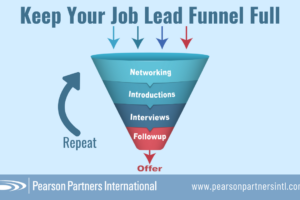
    photo of Lisa Thompson, Pearson Partners VP and Professional Career CoachAs a career coach, one of the mistakes I frequently see job seekers make is to work on one promising job lead at a time. This not only extends the length of the job search, but often leads to disappointing setbacks when the opportunity does not pan out. It can lead to feelings of constantly starting over and discouragement. Rather, you should continually build your job lead pipeline by sourcing your contacts and new opportunities—right up until your first day on the new job.

    These ten tips will help you to keep your job lead funnel full and land the right job:

    1. Commit full-time to your job search. The most successful job seekers are those who make their search a full-time job. Landing your next position should be your business and not a hobby. Write a plan for your business, including financial projections. Your initial investment is like liquid assets, so review this plan regularly. By using a dedicated and structured approach, you can make sure you keep a continual flow of leads and opportunities in the pipeline. Prepare to market yourself and set daily and weekly goals for meetings, follow-up and phone calls.
    2. Keep working options. There are no “sure things” when it comes to conducting your job search. In the recruiting industry, I have seen countless candidates put their search on hold while they are anticipating an offer, only to have the deal fall through. In fact, it is common practice for companies to enter into final negotiations with two or more final candidates. They understand that there may be other candidates out there who offer different skills or experience. Many times, the funding for a position is cut or someone in an important position in the company submits a last-minute candidate. Even when you are in the negotiating stage, the deal can turn sour and the offer can be withdrawn. Until your first day on the job, you need to keep working all possible options.
    3. Manage your time. The most common complaints I hear from job seekers are related to time management. It is easy to get diverted by other day-to-day tasks and the demands made by others. The more you delay your total commitment to your search, the longer it will take you to land. If you can’t work full-time on your job search, try to commit a dedicated time block each day when you will focus exclusively on your job search tasks—perhaps at the beginning of the day before distractions get in the way—and revisit it at the end of the day to reevaluate your task list for the next day. (Read our strategies for avoiding “task toggling” for more effective time management.)
    4. Remain neutral. Don’t get emotionally attached to a single opportunity. Keep working on other leads and opportunities until the offer is accepted and you actually start in your new role. In fact, your negotiating position is stronger if you have multiple offers or potential offers to leverage.
    5. Leverage your network. Your network is the main source of new leads and information. It is the exception to the rule in today’s job market that a quality position is posted on public boards. Contrary to popular belief, professional recruiters and job boards only account for 10% of the jobs filled. You have to tap into the “private” job market. That is, those that have yet to go public. Schedule meetings for informational interviews with industry-leading individuals and target companies. Circulate your target list to everyone in your network to get their help in gathering information and making connections. Continue to expand your professional contacts through networking events (including virtual events) and getting two to three new leads from each person you meet.
    6. Be prepared. Most importantly, remember that you typically have only one shot with each contact. Get your story straight and be prepared to offer a compelling reason for and clear vision of your direction. It is often the best-prepared candidate that gets the offer, not necessarily the best-qualified. (Read our tips for preparing for an interview, with practice questions for the seven types of interview questions.)
    7. Know the market. Do your research on other industries that are hiring where your skills and expertise can be a fit. Don’t just rely on targeting the companies closely related to your past experience. This targeting evolves as the economy and new technologies and services evolve. (Read our tips on targeting hot industries in an uncertain economy and strategies for switching industries to apply your skills to new targets.)
    8. Ask for help. Seek a professional career coach (the best are certified coaches who have been through training and are bound by ethical guidelines) who can help you uncover new opportunities, develop your objectives and define your skills as they apply to various industries. A professional career coach can also help you best position yourself to be able to pivot to a different industry. (Read some of our articles on executive coaching and leadership development.)
    9. Follow up on existing opportunities. As you continually target new opportunities, remember to follow up on existing ones. If it is taking a while to hear back from a recruiter or employer, check in periodically on the status of your candidacy, but don’t be discouraged if you don’t hear back regularly. Keep in mind that they are dealing with many unknowns regarding timing and they may not have an immediate answer. If you are working with a recruiter on a particular opportunity, be sure to reach out to the recruiter rather than the employer.
    10. Keep at it. Take control of your job search by continuing to network and develop opportunities. The more you are out there developing leads and prospects, the better your chances are of finding and landing the job you want.

    Above all, stay positive and focused and keep building your pipeline. If you follow these tips to keep your job lead funnel full throughout the course of your job search, you will be better prepared to land the job you want—and the job that’s right for you.

  • Tips for a Successful Job Search During a Pandemic

    Tips for a Successful Job Search During a Pandemic

    photo of Lisa Thompson, Pearson Partners VP and Professional Career CoachLisa Thompson, Vice President & Professional Career Coach, Pearson Partners International

    During the current COVID-19 crisis, it can be discouraging to see the rising unemployment figures and to know that it will likely continue to grow. You might be wondering: Should I put my job search on hold and give up on finding a new opportunity for the immediate future? If not, what can I do to ensure I stay top-of-mind for employers and ready to seize the next opportunity?

    “Difficulties mastered are opportunities won.”
    Winston Churchill 

    Now is the time to stay focused on your goals and redouble your job search efforts. Even during the most difficult times, companies continue to hire for critical positions. Those that are not doing so now will certainly need to ramp up hiring when they come out of their current holding pattern. The positions are there for those who have leadership skills and the courage to confront market challenges. If you are seeking a new opportunity, here are six tips on how to keep things moving forward in your career advancement.

    1. Build your network. Now is the time to be leveraging and expanding your professional network. Reach out to your network and let them know about your skills and where you can add value. While so many are working remotely and not traveling, it is a good time to reestablish relationships and to find out what is happening in their companies and industries. It is still true that many jobs are filled through networking connections, especially in the more senior roles. Make time to leverage social media networking opportunities to stay connected and to learn about potential job openings and leads.
    2. Be prepared. Get your resume and LinkedIn profile up-to-date and ready to go. Review your skills and experience and make sure you are highlighting your accomplishments. A good resume can play a strong supporting and defining role in your search by setting you apart from other executives and helping to communicate your skills, abilities, personal qualities and accomplishments to prospective employers. Your resume serves as an effective sales brochure to highlight your strengths and the contributions you can make to an organization. Recruiters and employers alike use LinkedIn to find candidates and to learn more about them. Take the time to update your resume and LinkedIn profile so they are consistent and representative of your expertise. Be sure to update your headshot so that it looks recent and professional.
    3. Practice for virtual interviews. In the age of “social distancing”, your interviews will more than likely be virtual. Prepare for phone and/or video interviews by practicing. Practice your answers in a mirror or on camera. Set up and learn to use the technology ahead of the interview. For video interviews, download the necessary programs and make sure the camera position, lighting and volume is correct. Be sure to remove anything distracting in the background. Find a quiet and comfortable place where you will not be interrupted. Read through the job description and do your research on the company, industry and interviewer(s) and develop questions to practice answering. (Here is a list of practice interview questions to get you started.) Prepare a list of talking points and questions you want to make sure you cover and keep it where you can reference it during the interview. Don’t forget to dress as if you were going for the interview in person. It will demonstrate your professionalism and seriousness about the opportunity.
    4. Be patient. Many positions have been put on hold or delayed, so be patient. Companies are still hiring in many industries, and in others, the delay will be temporary. If it is taking a while to hear back from a recruiter or employer, it is okay to check in periodically on the status of your candidacy, but don’t be discouraged if you haven’t heard anything in a while. Try to keep in mind that they are dealing with many unknowns regarding timing and they may not have an immediate answer.
    5. Improve yourself. This is a great time to work on developing your professional skills. You can increase your value in the job market by taking related courses, participating in training and earning professional credits or certifications. E-learning offers unlimited opportunities to pursue educational goals that will help enhance your prospects. If you are in a gap between jobs, potential employers will respect that you have used this time for personal and professional development.
    6. Care for yourself. Above all, remember to be kind to yourself and practice self-care. Be sure you are planning time in your schedule to exercise, eat right and relax. It is a stressful time for everyone—even more so if you are worried about finding a job. Take the time to care for yourself and to get the support you need to be successful in your efforts.

    We are resilient and we remain a country full of opportunity for those willing to work hard to achieve their dreams. We have survived wars, depression, recessions and tragedies and we will survive this. Now is not the time to go silent and to let uncertainty dampen your ambition. Be ready for when this is behind us and companies will be scrambling to find top talent. In the words of Winston Churchill, “Difficulties mastered are opportunities won.”

  • TweetChat: Executive Compensation Negotiation – November 1, 2016

    TweetChat: Executive Compensation Negotiation – November 1, 2016

    image of tweetchat banner

    A recent AESC BlueSteps Executive Career Insider TweetChat featuring Pearson Partners’ Renee Arrington (@ReneeBArrington) and our Pearson Partners team.

  • TweetChat: Executive Interviewing Tips – September 20, 2016

    TweetChat: Executive Interviewing Tips – September 20, 2016

    image of tweetchat banner

    A recent AESC BlueSteps Executive Career Insider TweetChat featuring Pearson Partners’ Lisa Thompson, LPC, PCC (@CareerCoachLisa) and our team.

  • TweetChat: Compensation Negotiation – March 22, 2016

    TweetChat: Compensation Negotiation – March 22, 2016

    A recent BlueSteps Executive Career Insider TweetChat featuring Pearson Partners’ Frank Morogiello (@Morogiello) and our team.

    image of tweetchat banner

    TweetChat: Executive Compensation Negotiation – March 22, 2016