Pearson Partners International

Tag: Forecast

  • Strategic Agility in a Shifting Landscape: How Texas Businesses Are Navigating Uncertainty

    Strategic Agility in a Shifting Landscape: How Texas Businesses Are Navigating Uncertainty

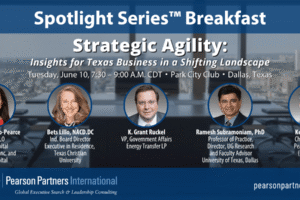
    As Texas business leaders continue to navigate a volatile global environment, agility, resilience and clear-eyed strategy have become central to sustaining growth. At the June 10 Pearson Partners Spotlight Series™ breakfast, panelists discussed how companies across industries are managing today’s complex landscape—marked by geopolitical uncertainty, economic headwinds, regulatory flux and rapid technological evolution.

    While the conversation touched on a wide range of opportunities and challenges, several consistent themes emerged: the importance of proactive risk planning, the enduring strength of the Texas economy and the need to embrace innovation, especially amid disruption.

    Strategic Foresight in a Complex Landscape

    Setting the tone for the discussion, one panelist noted:

    “The number one question clients are asking right now is how to navigate uncertainty.”

    From economic instability and fluctuating trade policies to inflation and interest rate volatility, business leaders face no shortage of risks. Yet panelists emphasized that companies cannot afford to sit still and wait for guidance.

    “Scenario planning is essential,” a panelist advised. “The organizations that took time to prepare with ‘if-then’ models last year are faring far better today.” The panel discussed several risk mitigation strategies, including capital-based planning and stress-testing long-term contracts.

    The conversation frequently returned to the concept of tariff whiplash, a term several panelists used to describe the ongoing unpredictability in U.S. trade policy. Rather than react defensively, forward-looking companies are embracing a more strategic approach, with many planning for inflation, buffering inventory and diversifying their product, service and supply portfolios. As one panelist said, “We are in a new world order. Tariffs are not going away, but that doesn’t mean we can’t adapt and find opportunity in the disruption.”

    Meeting the Challenges Ahead

    While Texas’ growth trajectory and business optimism remain strong, several panelists emphasized that continued success would depend on the state’s ability to address several persistent and emerging challenges.

    As Texas experiences rapid population growth and corporate relocation, its water and power infrastructures are among the state’s most pressing challenges. As one panelist noted, “The state has been working on water access legislation for decades, but the conversation is becoming more urgent as demand rises.” Similarly, the power grid must continue to evolve to meet the demands of a growing population, increased industrial activity and the significant energy needs of AI and data center expansion.

    Another key concern the panelists raised was workforce readiness. As digital transformation accelerates, there is a risk that Texas could fall behind other global innovation centers if the state does not continue to prioritize investments in education and talent upskilling/reskilling, especially for AI adoption.

    “We are moving into an era where basic tasks will be automated,” a panelist observed. “We must prepare our workforce to move into higher-value roles, or we risk losing our edge to other innovation hubs, both nationally and globally.”

    The panel also emphasized the crucial role of public-private partnerships in fostering innovation and resilience. Collaborations between government, academia and industry will be essential for navigating complex issues, from economic uncertainty to technological adoption and regulatory change. “Public-private partnerships are one of the most effective ways to maintain momentum while absorbing external shocks,” one panelist noted.

    Other concerns mentioned included housing shortages and immigration policies, both of which directly affect Texas’ ability to attract and retain top talent. “Texas is the top U.S. trading partner with Mexico,” one panelist pointed out. “We need thoughtful immigration and trade strategies if we want to maintain our workforce and economic vitality.”

    Panelists shared practical steps companies can take to mitigate these risks, including:

      • Scenario planning
      • Financial modeling
      • Stakeholder engagement
      • Flexible contract adoption
      • Automation and AI investment
      • Consistent communication
      • And more

    As one speaker succinctly said:

    “It’s not about avoiding the storm—it’s about learning how to navigate through it.”

    Texas: Resilient, Optimistic and Well-Positioned

    Panelists were bullish on Texas’ long-term outlook and its readiness to mitigate these challenges. The state’s position as the eighth-largest economy in the world, together with its deep labor pool and business-friendly policies, continues to insulate it from many of the shocks felt elsewhere.

    “We recently surveyed over 750 CEOs across the state,” shared one panelist. “85 percent were optimistic about Texas, while recognizing that the short term could be bumpy.”

    Panelists pointed to the growing momentum behind the Texas Stock Exchange, recent business court legislation and new protections for corporate officers and directors as signs that Texas is well-poised for business growth and innovation. The panelists agreed that these changes are likely to attract even more companies to relocate to or incorporate in Texas.

    “The framework is there,” a panelist noted. “With consistent regulation, supportive legislation, and the right infrastructure, we’re setting the stage for a new era of corporate growth in Texas.”

    Redefining Resilience: From Cost Efficiency to Strategic Flexibility

    Resilience in this environment requires more than just grit. It demands a shift in mindset. Historically, companies optimized supply chains for efficiency. Today, they must build them for adaptability.

    “We’ve moved from a just-in-time mindset to a just-in-case reality,” said one panelist. “It’s not just about raw materials anymore. You must understand your entire supply network—labor, packaging, secondary suppliers—and build redundancy where possible.”

    The discussion highlighted how companies are retooling legacy frameworks, such as lean manufacturing, to accommodate this new approach. One panelist shared an example of a major automaker that pioneered lean production but is now stockpiling semiconductors to ensure manufacturing continuity.

    Technology plays a vital role in enabling this transformation. Panelists mentioned cloud computing, blockchain, automation and AI as tools for gaining real-time visibility and supporting strategic decision-making.

    “Details matter,” a panelist emphasized. “Whether you’re talking about integrating financial and operational systems or mapping supply chain risks down to Tier 2 and Tier 3 suppliers, it’s the details that drive resilience.”

    The Power of Communication and Culture

    One of the most pragmatic takeaways from the event was the value of internal alignment. A panelist described his organization’s daily cross-functional meetings, likening them to a “war room,” where senior leaders in operations, legal, government affairs and investor relations share updates and anticipate regulatory shifts.

    “Clear, consistent communication across the business is how we stay ahead,” the panelist explained. “It’s how we manage risk, spot opportunities and move faster.”

    This internal discipline extends to external relationships as well. Scenario planning with suppliers and building flexible contract terms are essential ways to absorb shocks and maintain continuity with partners and clients.

    Innovation at the Center of Growth

    Texas’ legacy of innovation and its growing ecosystem of tech hubs, universities and startups featured prominently in the conversation. From renewable energy and sustainable development to autonomous transportation and smart manufacturing, panelists agreed that Texas is defined by forward-thinking enterprise.

    One panelist shared her perspective on Texas’ entrepreneurial energy:

    “There is a bias for action in Texas. We don’t wait for perfect conditions. We solve problems and build solutions.”

    That same resilient spirit applies to AI adoption. While data quality and governance still present risks, panelists uniformly encouraged companies to embrace AI as an operational enabler.

    “AI is not going away,” one panelist noted. “You may not lose your job to AI, but if you don’t understand it, you may lose it to someone who does.” Others urged leaders to experiment, invest in training and involve younger professionals who are already fluent in the tools and use cases.

    What’s Next for Texas?

    To wrap up the discussion, Pearson Partners Advisor Dr. Robert Potter asked our panelists to share their outlook for Texas business five years from now. All were optimistic, with some boldly predicting that the number of Fortune 500 companies headquartered in Dallas/Fort Worth alone (currently eleven) would double, driven by business-friendly initiatives and economic momentum.

    One panelist best summarized the discussion:

    “Texas is open for business. With the right strategy, investment and foresight in place, we are just getting started.”


    Pearson Partners International helps executives and organizations navigate complex dynamics through our quarterly Spotlight Series™ events—continuing the conversation on leadership, strategy and the future of work.

    Learn more about the Pearson Partners Spotlight Series™ breakfast events.

  • Navigating the Labor Market Amid Fed Pressure and Policy Shifts

    Navigating the Labor Market Amid Fed Pressure and Policy Shifts

    Dallas-area business leaders gathered recently for Pearson Partners International’s first-quarter Spotlight Series™ breakfast to discuss a topic that has become central to boardroom conversations: the future of the labor market in a time of economic and policy uncertainty.
    With layoffs dominating the headlines and shifting public policies impacting everything from trade to immigration, companies are grappling with how to manage talent, develop leaders and navigate unpredictable market dynamics. This candid discussion, led by Pearson Partners’ President and COO Renee Arrington, explored the challenges and opportunities business leaders face in managing their most valuable resource: their people.

    A Labor Market in Flux

    How do we ensure stability and growth in an environment where so much feels uncertain?

    – Renee Arrington, President & COO, Pearson Partners International

    In her opening remarks, Arrington noted that the morning’s stormy weather was an apt metaphor for the current labor market—unsettled, shifting and filled with uncertainty. “We’ve seen a lot of changes as we take the business pulse,” she said, citing widespread layoffs in major companies like Amazon, Microsoft, Tesla and Southwest Airlines. Retailers like Jo-Ann and Big Lots are closing stores or scaling down, while others, including Starbucks and Chevron, are tightening their belts in anticipation of more turbulent times.

    A panelist later pointed out that while these job cuts are often attributed to economic headwinds, the root causes remain complex and multifaceted. Factors such as immigration policy, global trade disruptions and evolving labor market expectations all play a role.

    Policy Shifts and Business Implications

    One of the most pressing issues discussed was the impact of recent federal policy shifts, as the newly formed Department of Government Efficiency (DOGE) and new tariff initiatives send ripple effects through multiple sectors.

    A panelist with deep experience in international labor law noted that the DOGE initiative is prompting public agencies and private companies to conduct similarly fashioned internal audits to eliminate inefficiencies and redundancies. “States are following suit,” said the panelist, with several launching reviews focused on rooting out bloat and fraud.

    While these efforts may lead to greater efficiency, they are also triggering mass layoffs within government agencies. These layoffs are impacting services that businesses depend on, creating bottlenecks and delays in areas like immigration processing and regulatory approvals.

    On the trade front, the conversation centered on the administration’s tariff policies. A panelist remarked that while tariffs were once thought to be merely a negotiating tactic, they are now being implemented in full, driving up costs on raw materials and imported goods. For example, produce and automotive parts sourced from Mexico and Canada are already seeing price increases due to steep tariffs. These pressures are fueling concerns about inflation and creating additional costs for manufacturers and retailers.

    Bringing jobs back to the U.S. is part of the strategy,” noted one panelist, “but it’s also driving wage inflation as companies compete for workers to fill these new roles.”

    At the same time, the tariffs are designed to incentivize domestic job creation. However, one panelist noted that tariffs and immigration policy might work together to increase labor costs—especially in comparatively lower-wage industries like agriculture, construction and manufacturing.

    Remote Work, Return-to-Office Mandates and Company Culture

    Another focal point of the conversation was the ongoing challenge of managing the return to the office. Some organizations are finding that a hybrid workforce complicates efforts to foster collaboration, innovation and a cohesive company culture.

    As one panelist noted, companies that require employees to be in the office two or three days per week are seeing mixed results. In some cases, leaders are concerned that employees return only to spend their time on video calls, defeating the purpose of in-person collaboration.

    We can’t ask people to come in just to sit in virtual meetings,” a panelist emphasized. “We need intentionality—planned collaboration, problem-solving sessions and team-building initiatives.”

    Another panelist quipped that it’s time to “make offices great again,” highlighting the need to create spaces where employees want to work, not just where they are required to be. The panelist cited in-person interactions, serendipitous conversations and informal mentoring opportunities as key benefits of being on-site—benefits that are hard to replicate in a fully remote environment.

    Leadership Development and Succession Planning

    The conversation also explored the challenges of developing the next generation of leaders, particularly middle managers who often bear the brunt of organizational change. Several panelists observed that management roles have become less attractive to employees who see leadership as fraught with stress, complex responsibilities and limited rewards.

    One panelist suggested that companies need to “make management cool again,” focusing on the intrinsic rewards of leadership and reinforcing the value of mentoring and developing others. Financial incentives are part of the equation, but personal fulfillment and a sense of purpose are equally important.

    Another panelist noted that veterans bring valuable leadership experience and resilience, making them ideal candidates for middle management roles. Companies that actively recruit and support veterans are benefiting from their ability to lead teams through complex and challenging environments.

    Panelists also discussed the resurgence of corporate universities and internal leadership programs. One example shared was a global organization that partnered with an executive education provider to create a customized culture alignment and leadership development initiative. While some companies have moved away from traditional corporate universities due to cost concerns, others are finding that targeted, scalable programs—often delivered in hybrid formats—can effectively prepare future leaders.

    Technology’s Expanding Role in Talent Management

    The panel also addressed the role of technology—particularly artificial intelligence (AI)—in transforming workforce management. One panelist pointed out that AI tools are being used in the legal profession to automate document drafting and case research. While these technologies can enhance efficiency, they also raise legal and ethical questions—particularly in recruitment, where AI-driven systems may inadvertently introduce bias. The takeaway? Embrace AI, but do so with caution and oversight.

    Another example highlighted the concept of “hybrid intelligence,” where AI works alongside human expertise to improve decision-making and productivity. In the context of talent management, leaders must ensure their teams are trained to leverage technology effectively, starting with leadership and cascading throughout the organization.

    “Some people fear that AI will take their jobs,” one speaker noted. “But in fact, the jobs that AI will replace are those of people who don’t know how to use it.”

    Generational Shifts and Labor Market Expectations

    The panel also addressed the growing complexity of managing a multigenerational workforce. With five generations now working side by side, leaders must navigate differing values, motivators, expectations and communication styles.

    Illustration of the traditional VUCA model reframed: Vision, Understanding, Clarity, AgilityOne panelist shared how business leaders are reframing the traditional VUCA model (volatility, uncertainty, complexity, ambiguity) into a more positive framework: vision, understanding, clarity, agility.

    This forward-thinking mindset can help leaders and organizations focus on long-term purpose while remaining flexible in the face of ongoing change.

    Inflation and Economic Predictions

    As the discussion concluded, Pearson Partners Advisor Dr. Robert Potter posed a question to the room: Where are prices headed in the next year? Almost all the panelists and audience predicted that inflation would continue to rise, citing factors such as wage pressures, tariffs and immigration constraints.

    However, a few attendees offered a more optimistic view, suggesting that increased efficiency and technological advancements could help stabilize prices over time.

    A Time for Thoughtful Leadership

    In his closing remarks, Keith Pearson, Chairman and CEO of Pearson Partners International, acknowledged the importance of navigating this challenging environment with clarity and collaboration.

    We need to be intentional about how we lead—whether in our approach to developing talent, managing change or building partnerships across industries.

    – Keith Pearson, Chairman and CEO, Pearson Partners International

    Arrington agreed, emphasizing that while uncertainty is a given, business leaders can make a difference by fostering a sense of purpose and connection within their organizations.

    We have done this before. We managed through COVID. We adapted. We innovated. And we can do it again.

    – Renee Arrington, President & COO, Pearson Partners International

    As always, Pearson Partners International remains committed to helping executives and organizations navigate these complex dynamics through its quarterly Spotlight Series™ events—continuing the conversation on leadership, strategy and the future of work.

    Learn more about the Pearson Partners Spotlight Series™ breakfast events.

  • Future Texas:  Industry and Innovation in the Texas of Tomorrow

    Future Texas: Industry and Innovation in the Texas of Tomorrow

    Texas is on a remarkable trajectory, leading the nation in population growth, job creation and industrial innovation. As home to more Fortune 500 companies than nearly any other state—and with a GDP that, if it were a country, would make it the eighth-largest economy in the world—Texas stands at the forefront of America’s future economic growth.

    But with that success comes a new set of challenges: How does Texas manage the infrastructure demands of a growing population? What are the energy implications of rapid industrial expansion? And how can the state continue to foster talent development and retention to maintain its competitive edge in an increasingly globalized economy?

    These were just a few of the questions explored at Pearson Partners International’s recent Spotlight Series™ breakfast, held September 10 at Park City Club in Dallas. The event drew senior executives and business leaders from across the region to discuss “The Texas of Tomorrow.” Moderated by Renee Arrington, President and COO of Pearson Partners International, the conversation centered on how industry and innovation will shape Texas’ future—and what business leaders can do today to help guide the way.

    Texas: A Powerhouse Economy with Room to Grow

    In her opening remarks, Arrington painted a vivid picture of Texas’ economic heft. With a GDP of $2.4 trillion, Texas would be the eighth-largest economy in the world if it were a country, surpassing countries such as Brazil, Canada, Italy and South Korea. Texas is the second state in the U.S. to reach a population of 30 million residents—and it is not slowing down. “We are adding 1,000 people to our state every single day,” Arrington noted, citing projections that put the state’s population at over 40 million by 2060.

    This growth has accompanied a surge in business investment and corporate relocation. Texas is now home to 55 Fortune 500 companies, with 24 in the Dallas-Fort Worth area. The state’s financial services hub is booming, luring powerhouses like Goldman Sachs, JPMorgan Chase, Charles Schwab and Fisher Investments and earning the city the nickname “Y’all Street.” The NYSE is moving its Chicago branch to Dallas and reincorporating it as NYSE Texas. Over 200 companies have relocated to Texas since 2020, including Chevron, Oracle, Google, Tesla, HP, McKesson and others.

    At the same time, the state’s economic success raises important questions about sustainability, infrastructure and long-term planning.

    “How do we support the underpinnings of what makes our state great so Texas can continue to be a magnet for people, business and innovation?”
    – Renee Arrington, President & COO, Pearson Partners International

    The Power Conundrum: Balancing Growth with Grid Reliability

    One of the most pressing infrastructure challenges Texas faces is energy. The state’s grid has struggled to keep up with demand, particularly during extreme weather events like Winter Storm Uri in 2021. A panelist with extensive expertise in energy strategy and sustainability explained that Texas’ competitive energy market is unique in several ways. Unlike other regional power grids in the U.S., the ERCOT (Electricity Reliability Council of Texas) grid is largely isolated, or “islanded,” meaning it cannot easily draw power from outside sources when demand surges.

    While Texas has led the nation in deploying renewable energy—particularly wind and solar, which have grown five-fold in Texas in the last 20 years—dispatchable generation such as natural gas and nuclear power has remained flat for nearly two decades. In 2010, dispatchable generation made up 92 percent of the state’s energy portfolio. By 2023, that number had dropped to 48 percent with renewables and battery storage accounting for the balance.

    “The renewable growth is exactly what we want,” the panelist noted. “But on those very hot or very cold days, when the sun isn’t shining and the wind isn’t blowing, we need reliable, on-demand power. And we’re not building enough of it.”

    Despite the challenges of balancing its energy mix, Texas continues to lead the nation in renewable energy generation. The state ranks No. 1 in the country in wind power capacity and is rapidly expanding its solar energy output, outpacing many other U.S. states in clean energy investment. Panelists highlighted that Texas’ vast land resources, favorable regulatory environment and innovative private sector have made it a global model for renewable energy deployment. However, as one panelist noted, while renewable energy now accounts for over 50 percent of Texas’ energy resources on an average day, it must be paired with dispatchable generation to ensure reliability during periods of high demand. The challenge moving forward is not a lack of renewable energy leadership, but ensuring a resilient, flexible grid that can support continued economic growth and decarbonization goals.

    Programs like the Texas Energy Fund encourage new investment in dispatchable generation, particularly natural gas plants. However, there is concern that government subsidies—while helpful in the short term—could distort the market and create long-term inefficiencies. “The best solution is a competitive market that works on its own,” the energy industry panelist emphasized, “but that requires the right investment signals and a clear understanding of the economics.”

    Nuclear Energy: A Critical, Yet Complex, Component of the Future Grid

    The conversation also delved into the role of nuclear energy in meeting Texas’ growing power needs. As one panelist explained, nuclear energy remains the only form of clean, carbon-free power that operates reliably 24/7. However, building new large-scale nuclear plants in the U.S. is fraught with regulatory challenges and astronomical costs. The most recent example is Georgia’s Vogel plant, which cost nearly $40 billion to build—a staggering sum compared to the $1 billion it typically costs to build a new natural gas plant in Texas.

    While the economics of large-scale nuclear are daunting, panelists expressed cautious optimism about the potential of advanced nuclear technologies, such as small modular reactors (SMRs). These systems offer a smaller, less risky investment and could play an important role in the energy mix within the next decade. Texas’ Advanced Nuclear Working Group is actively exploring ways to bring these technologies to market.

    “If we want to decarbonize the grid long term,” noted the energy industry panelist, “and I would argue we will do so by 85 years or more in the future, then you have to have nuclear because it doesn’t work otherwise.”

    The Role of Public Policy in Shaping Texas’ Future

    The discussion also highlighted the critical role of national and state policy in shaping Texas’ future. Several panelists noted that federal subsidies for renewable energy have skewed the ERCOT market, making it difficult for new investments in natural gas and nuclear to compete on equal footing. Yet without government support, some sectors—such as space and advanced nuclear—may struggle to scale.

    “Texas has all the resources it needs to lead,” one panelist concluded. “But what we lack is a long-term policy vision. We need to think in terms of decades, not just election cycles.”

    Global Connectivity Starts with Talent Development

    A recurring theme in the discussion was talent—attracting it, developing it, and keeping it in Texas. One panelist, a former defense industry CEO, stressed that while Texas is growing in population, it is behind in long-term investment in education and research.

    “Talent development doesn’t happen overnight,” a panelist said. “It’s a multi-decade investment that starts in early education and carries through universities and research institutions.”

    Fort Worth is an example of a city poised for transformation. Despite being the 12th largest city in the U.S., Fort Worth lacks a leading research university. That is beginning to change. Texas A&M is establishing a new engineering campus there, and UT Arlington has announced plans to expand west of the city. These developments are part of a broader push to create a high-tech innovation zone that can rival those in Boston, California and New York.

    One panelist likened this long-term investment to the establishment of a new ecosystem. “It’s not just about getting degrees,” he explained. “It’s about building the infrastructure for innovation, attracting global commerce, and making Texas a hub for collaboration with other states and countries.”

    Space: The Next Frontier for Texas Innovation

    Texas’ pioneering spirit has long been part of its identity, and that ethos continues in the state’s central role in the private space industry. A panelist with deep experience in space investment described how Texas has been instrumental in the development of private space exploration. While Houston has long been home to NASA’s Johnson Space Center—ground control for America’s early manned space missions and a key player in the space shuttle program and the International Space Station—other regions of Texas are now accelerating the growth of the private space sector. SpaceX has announced its plan to relocate to Austin, and the state now hosts a growing ecosystem of aerospace startups, including those focused on small satellite technology and 3D-printed rocket motors.

    The same panelist credited Dallas’ business-friendly environment with helping to make private space ventures viable. She explained, “I would argue that Dallas is the reason there’s a private space industry in the world today,” citing the Ansari family’s role in funding early private space initiatives after building their telecom fortune in North Texas. Their sponsorship of the Ansari X-Prize for space exploration led to the development of Burt Rutan’s SpaceShipOne, the first privately funded spacecraft—and the predecessor to Richard Branson’s SpaceShipTwo (SS2), now part of Virgin Galactic’s commercial spaceflight program.

    “I would argue that Dallas is the reason there’s a private space industry in the world today,” said one panelist.

    The newly established Texas Space Commission, appointed by Governor Abbott, underscores the state’s commitment to advancing this sector. The commission’s emerging public-private partnerships are paving the way for the state to play an even larger role in the global space economy.

    What’s Next for Dallas and Texas?

    The consensus among the panelists was clear: Texas must balance short-term needs with long-term vision. Thoughtful, strategic planning is essential in energy, space, defense, education and advanced manufacturing.

    “We have all the ingredients for success. But we need to be intentional in how we leverage them.”
    – Renee Arrington, President & COO, Pearson Partners International

    As the discussion concluded, Pearson Partners Advisor Dr. Robert Potter posed a final question to the panel: Where will Dallas rank among the most populous U.S. cities in 2050? The unanimous prediction: By 2050, Dallas will rise from its current position as fourth to become the second most populous city in the country.

    In his remarks, Keith Pearson, Chairman and CEO of Pearson Partners International, underscored the importance of conversations like these:

    “This is an exciting time to be in Texas. But to fully realize our potential, we need collaboration—across industry, government and education—to meet the challenges ahead.”
    – Keith Pearson, Chairman and CEO, Pearson Partners International

    Pearson Partners International will continue to facilitate these critical discussions through its quarterly Spotlight Series™ events, helping business leaders navigate the evolving landscape of Texas’ economy and prepare for the future of industry and innovation.

    Learn more about the Pearson Partners Spotlight Series™ breakfast events.

  • Fireside Chat on the U.S. and Mexico Presidential Elections

    Fireside Chat on the U.S. and Mexico Presidential Elections

    Photo of Pearson Partners Spotlight Series breakfast speakers Q22024: U.S. and Mexico Presidential Elections
    Keith Pearson (L) and Rodrigo Aguilar Benignos (R)

    At our second-quarter Pearson Partners Spotlight Series™ breakfast on June 11, business leaders gathered for a timely and engaging fireside chat on the evolving U.S.–Mexico relationship. As both nations head into pivotal election years, our discussion explored the potential impact on trade, security and global business.

    Keith Pearson, chairman and CEO of Pearson Partners International, welcomed attendees and shared insights from his recent trip to Mexico as an international election observer. The morning’s highlight was his conversation with Rodrigo Aguilar Benignos, senior advisor at APCO and U.S. Council on Foreign Relations member. Drawing on his expertise in international relations and trade, Rodrigo offered an in-depth analysis of Mexico’s recent historic election and what lies ahead for U.S.–Mexico relations.

    Key Takeaways

    Historic Election with Global Implications

    Mexico’s June 2 election marked a historic moment as Claudia Sheinbaum was elected the nation’s first female president. With more than 20,000 posts on the ballot, the election was widely viewed as a referendum on outgoing President Andrés Manuel López Obrador’s (AMLO) policies. Sheinbaum’s landslide victory signals a continuation of AMLO’s political agenda, though many question how independently she will govern.

    U.S.–Mexico Trade: A Critical Relationship

    Rodrigo highlighted the strength of the U.S.–Mexico trade partnership, which surpasses $779 billion annually—more than the combined U.S. trade with the United Kingdom, Germany, South Korea and Japan. Every minute, $1.5 million in goods and services cross the border, making Mexico the U.S.’s largest trading partner. This interdependence underscores the importance of maintaining stability and collaboration between the two countries.

    Security and the Challenge of Organized Crime

    Reducing violence and combating organized crime remain top challenges for the new administration. Despite Sheinbaum’s success in lowering crime rates in Mexico City, scaling those efforts nationwide will be far more complex. Rodrigo emphasized that addressing cartel influence will be a key test of her leadership. While optimism remains, the task is daunting.

    Nearshoring Opportunities and Infrastructure Hurdles

    The fireside chat explored the growing trend of nearshoring: moving offshored U.S. manufacturing from China to Mexico. Rodrigo noted that many U.S. companies view Mexico as a reliable partner with a talented workforce, particularly in engineering and manufacturing. However, Mexico must overcome infrastructure limitations—such as energy reliability, water availability and transportation—to fully capitalize on this opportunity.

    What’s Next for USMCA?

    The upcoming review of the USMCA trade agreement in 2025 will be a critical milestone. Rodrigo expressed cautious optimism that the agreement will continue to provide the stability and certainty businesses need, though he also acknowledged potential risks if constitutional reforms and political shifts disrupt investor confidence.

    The Fentanyl Crisis: A Shared Responsibility

    The discussion addressed the fentanyl crisis, noting increased cooperation between Mexico and the United States. While Lopez Obrador’s administration handed control of Mexico’s ports to the Navy to curb fentanyl trafficking, Rodrigo believes further collaboration and enforcement will be necessary under Sheinbaum’s government.

    Action Items for Business Leaders

    • Strengthen cross-border cooperation on security and counter-narcotics efforts, particularly in addressing the fentanyl crisis.
    • Monitor developments around USMCA, as the upcoming review process could impact trade and investment strategy.
    • Invest in talent development and infrastructure to capitalize on nearshoring opportunities in Mexico’s evolving manufacturing landscape.

    Closing Reflections

    As Rodrigo succinctly said, “We are at a pivotal moment in the U.S.–Mexico relationship.” With both nations undergoing significant political transitions, the conversation reinforced the critical need for engagement, understanding and partnership.

    Pearson Partners extends our sincere thanks to Rodrigo Aguilar Benignos for sharing his valuable insights and to our attendees for their thoughtful questions and participation. We look forward to continuing these important conversations at our upcoming Spotlight Series™ events.

    Learn more about the Pearson Partners Spotlight Series™ breakfast events.

  • The U.S. and China: The Struggle for World Leadership

    The U.S. and China: The Struggle for World Leadership

    Photo of Pearson Partners Spotlight Series breakfast panelists Q42023: The U.S. and China
    Patrick Walsh, Ashley Yablon, Renee Arrington, Michael Frank, Stephen Konstans, Keith Pearson

    At the Pearson Partners Spotlight Series™ breakfast held on December 12, 2023, “The U.S. and China: The Struggle for World Leadership,” we convened a distinguished panel of thought leaders in economics, geopolitics and trade to discuss one of the most pressing global issues. This installment in our quarterly breakfast series provided a platform for an enlightening dialogue on the evolving dynamics of U.S. and China relations. As tensions continue to escalate between the two global superpowers, the implications for business, the economy and our community have never been more significant.

    Pearson Partners Spotlight Series™ Breakfast Q4 2023

    Keith Pearson, Chairman and CEO of Pearson Partners, kicked off the event, setting the stage for an engaging discussion led by a panel of experts specializing in U.S./China relations:

    • Michael Frank (Senior Fellow, Wadhwani Center for AI and Advanced Technologies – Center for Strategic and International Studies), bringing a broad geopolitical perspective
    • Admiral Patrick M. Walsh, PhD, Four-Star Admiral, Retired, United States Navy, with significant firsthand experience in military and strategic affairs
    • Ashley K. Yablon, Attorney at Law, an author and former expat with extensive experience working in major Chinese telecom companies
    • Stephen Konstans (Moderator), former Senior Vice President and Financial Officers Practice Leader, Pearson Partners International

    Key takeaways from the discussion for the next five to ten years in the context of U.S./China relations, along with related quotes (anonymously attributed) included:

    Strategic Global Positioning

    The discussion on military and economic strategies between the U.S. and China stressed the importance of strategic positioning in a rapidly changing global landscape.

    “Adapting to China’s business culture is not just challenging; it is crucial for success. It’s about understanding a different way of doing business.”
    – Pearson Partners Spotlight Series Panelist

    Risk Management in International Operations

    The panel’s insights into China’s political and economic policies provided a framework for understanding and managing risks in international operations, especially in volatile geopolitical climates.

    “We are witnessing a significant shift in military power balance—one that requires a thoughtful and proactive response from the U.S.”
    – Pearson Partners Spotlight Series Panelist

    Navigating Supply Chain Challenges

    Insights into the global trade tensions between the U.S. and China reminded us of the potential volatility in supply chains and the importance of diversifying suppliers.

    “It’s not just about territorial claims. It is a strategic move to control crucial global trade routes.”
    – Pearson Partners Spotlight Series Panelist

    Innovation and Competitive Edge

    The discussion on the technological race between the U.S. and China reinforced the need to invest in innovation to maintain a competitive edge in the global market.

    “The U.S.-China trade relationship is at a crossroads. It is a complex interplay of competition and interdependence.”
    – Pearson Partners Spotlight Series Panelist

    Importance of Geopolitical Awareness

    The session highlighted the importance of being aware of geopolitical developments and their potential impacts on various aspects of multinational operations, from trade to investment strategies.

    “[This is]… the most important foreign policy challenge for the United States in the 21st century. We are entering a period of potentially maximum danger for this relationship.”
    – Pearson Partners Spotlight Series Panelist

    The event concluded with a vibrant Q&A session with our audience. Keith Pearson wrapped up the discussion by reflecting on the insights shared by the panelists. He noted the complexity of the relationship between the U.S. and China and its implications for global leadership, underscoring the need for a strategic, informed approach to handling the complex interplay of economic, political and cultural factors in this pivotal geopolitical contest.

    Learn more about the Pearson Partners Spotlight Series™ breakfast events.

  • The Shift from China to Mexico: Redefining Global Partnerships

    The Shift from China to Mexico: Redefining Global Partnerships

    The global economic landscape is rapidly transforming, compelling many businesses to reevaluate their investment and partnership approaches—particularly in China. Rising labor and manufacturing costs in China, trade tensions, supply chain shortages and escalating political uncertainties have prompted many companies to seek alternatives. Mexico is gaining popularity as a global partnership destination. A recent Deloitte study projects a 10 percent annual growth in foreign direct investment (FDI) in Mexico, reaching over $60 billion by 2027. For U.S. companies decoupling with China, Mexico is a favorable choice due to its economic stability, strategic proximity and promising growth opportunities.

    Photo of Pearson Partners Spotlight Series breakfast panelists Q12024
    José (Pepe) Guevara, Alberto de la Peña, Renee Arrington, Keith Pearson, Darla Roden, Jeff Cartwright

    In our Q1 2024 Pearson Partners Spotlight SeriesTM breakfast, held on March 5, 2024, we convened a panel of experts for a compelling dialogue building on our December discussion on U.S./China relations. We discussed why these increasing challenges were driving many companies to cut ties with China and pivot to nearshoring in Mexico. Our speakers included:
    • José (Pepe) Guevara, Chairman & Chief Executive Officer, Pecan Grove Farms
    • Alberto de la Peña, Partner | Co-Chair – International Practice Group, Haynes Boone
    • Darla Roden, General Counsel, LALA U.S.
    • Jeff Cartwright, Managing Partner, Shoreview Management Advisors
    • Keith Pearson, Chairman, Chief Executive Officer & Co-Founder, Pearson Partners International (Moderator)

    The panel discussed the job creation and economic growth potential of partnerships with Mexico, as well as the country’s potential as a manufacturing hub for companies decoupling from China. However, they also highlighted challenges, such as understanding market and labor laws, establishing facilities throughout the country and addressing infrastructure challenges. The panelists delved into the intricacies of Mexico’s political landscape, including constitutional reforms and rule of law, and the challenges U.S. businesses face when investing in Mexico, including cultural and legal hurdles.

    Speakers addressed the (then-upcoming) Mexico presidential election, saying the outcome would impact U.S./Mexico trade, nearshoring and investment activity. (Pearson Partners further discussed the implications of Mexico’s presidential election during our subsequent Spotlight Series™️ breakfast on June 11, 2024.)

    Topics explored by our panel included:

    • Economic Realignment: Navigating changing factors in China and their impact on business strategies.
    • Trade Agreements and Policies: Understanding the role of agreements like the USMCA in shaping a new trade paradigm.
    • Geographical and Logistical Advantages: Leveraging Mexico’s strategic proximity for enhanced supply chain efficiency.
    • Cost Dynamics: Analyzing the costs of operations and manufacturing in Mexico versus China.
    • Cultural and Market Differences: Recognizing the differences in the culture and employment market in Mexico.
    • Market Access: Exploring Mexico’s gateway to diversified global markets.
    • Skilled Workforce: Tapping into Mexico’s pool of talented and skilled professionals.
    • Cultural and Economic Ties: Capitalizing on Mexico’s cultural compatibility, shared time zones and language capabilities.
    • Risk Management: Diversifying investments to mitigate geopolitical tensions, supply chain vulnerabilities and over-reliance on the Chinese market.
    • Sustainability and Social Responsibility: Harnessing Mexico’s environmental and social standards commitment to meet corporate ESG criteria.

    The insights shared during our Spotlight Series breakfast underscored a pivotal theme: Despite complexities, the opportunities for meaningful cross-border partnerships between the United States and Mexico are expanding at an unprecedented pace. As nearshoring becomes an increasingly attractive strategy for companies seeking resilience and efficiency, Mexico offers a compelling investment case. Its skilled workforce, favorable trade agreements and growing manufacturing capabilities position it as a critical player in the global economy.

    However, success in this evolving environment requires thoughtful leadership. Companies must look beyond traditional assumptions, perform careful due diligence and foster relationships that respect cultural nuances and legal frameworks. As several of our panelists noted, the most successful leaders will view this moment not as a defensive maneuver in response to global pressures, but as an offensive strategy to unlock new growth and innovation.

    The U.S.–Mexico partnership is not just a matter of proximity but of shared opportunity. At Pearson Partners International, we are committed to helping our clients navigate these complexities and seize the potential that lies ahead. We look forward to continuing these conversations in future Spotlight Series events—and to supporting senior leaders as they chart a course through today’s interconnected global landscape.

    Learn more about the Pearson Partners Spotlight Series™ breakfast events.

  • The Evolution and Future of Work-From-Home

    The Evolution and Future of Work-From-Home

    photo of lisa thompson pearson partners international
    by Lisa Thompson, LPC, PCC
    Vice President

    The work-from-home and work-from-anywhere (WFH/WFA) model has profoundly transformed in recent years. What was once considered a novel concept has become an integral part of the modern workplace. The COVID-19 pandemic accelerated the global shift towards remote work, and as a result, employers and employees have had to adapt to this new way of working. In this article, we explore the changing work-from-home environment, its impact on individuals and organizations and the future of remote work.

    The Pandemic Push: WFH Goes Mainstream

    The beginning of the COVID-19 pandemic forced organizations worldwide to rapidly implement remote work policies. In a matter of weeks in early 2020, offices emptied, employees set up makeshift home offices, and business leaders had to quickly adopt new ways of managing their teams. This unprecedented shift was challenging and eye-opening, revealing the potential of remote work while highlighting its shortcomings.

    Increased Flexibility: One of the most significant advantages employees gained from remote work was increased flexibility. Many employees were able to set their schedules, allowing for a better work-life balance. This newfound flexibility boosted morale and job satisfaction.

    Technology Adoption: Companies invested heavily in technology to support remote work. Video conferencing, project management tools and cloud-based applications became essential for communication and collaboration. This tech adoption paved the way for efficient remote work environments.

    Challenges of Isolation: While remote work offered many benefits, it also introduced difficulties such as social isolation, loneliness and blurred boundaries between work and personal life. Many employees missed the office camaraderie, and some struggled with burnout.

    Adapting to a Hybrid Future

    As the initial shock of the pandemic subsided, organizations began to rethink their long-term remote work strategies. Many adopted a hybrid approach, allowing employees to split their time between the office and home. This shift has had significant implications for the future of work.

    Office Redefined: Offices are evolving into collaboration hubs rather than traditional workspaces. In-person workplaces facilitate team meetings, brainstorming sessions and in-person collaboration, while employees can complete individual tasks remotely.

    Emphasis on Outcomes: With employees working in different locations, organizations are shifting from monitoring hours worked to measuring outcomes and productivity. This change in mindset promotes trust and empowers employees to manage their time effectively.

    Talent Pool Expansion: Remote work has broadened the talent pool for hiring. Companies supporting remote work can tap into a global talent pool while expanding opportunities for diversity and inclusion.

    Challenges and Solutions

    While the changing work-from-home environment offers numerous benefits, it also presents pressing challenges.

    Digital Fatigue: Prolonged screen time and virtual meetings can lead to digital fatigue. Organizations must promote breaks, encourage offline work and provide wellness and mental health support tools.

    Cybersecurity Concerns: Remote work can expose companies to cybersecurity risks. Robust security measures and technology deployment are essential to protect sensitive data and systems.

    Communication and Culture: Maintaining a strong company culture and effective, consistent communication can be challenging in a remote or hybrid setup. Regular team-building activities and clear communication channels are essential.

    Work-from-home has come a long way from its early days as a niche concept. The pandemic accelerated its adoption, bringing both opportunities and challenges. As organizations continue to adapt and refine their remote work strategies, the future of work will likely be a hybrid model combining the best of both worlds—the flexibility of remote work and the collaboration of in-person interaction. Companies must prioritize technology, well-being and a culture of trust and accountability to succeed in this evolving landscape. The changing work-from-home environment is here to stay, and those who embrace it will thrive.

  • Hiring Activity: 2020 & Beyond

    Hiring Activity: 2020 & Beyond

    Nationwide Business Leaders Weigh in on Hiring Plans During and After the Pandemic

    Pearson Partners International recently published a study on the business and economic impact of COVID-19. Over 500 business leaders participated from across the nation, representing companies ranging from small, private organizations to multi-national conglomerates. Along with questions about operational impact, business continuity and the economy, business leaders were asked about plans for hiring and staffing now and in the future.

    Below, we summarize these business leaders’ input on hiring activity and plans in the fourth segment in our series following the study.

    Capitalizing on a Slow Market

    While overall hiring has slowed, some companies have taken advantage of the opportunity to add star players to their teams during the economic downturn. One CEO said, “During this economic time, I have found that great opportunity is available with talented employees who would not have been previously available.” Several business leaders reported seeing an increased need for talent. One said, “My company is growing its market share and still needs employees to get that done.” At the board level, one CEO reported, “Demand for experienced board members and advisors has increased markedly in the past two to three months.”

    Over a tenth (11 percent) of respondents said that their companies plan to increase hiring in the next year. Of those, most (88 percent) said they expect to increase hiring by 10–25 percent. Respondents who reported plans to fill top positions within the next year said that they plan to hire people in customer service, executive management, engineering, information technology, marketing, public relations, risk management, legal, healthcare sales, marketing and business development. While most respondents (91 percent) did not anticipate creating any new job titles on their leadership teams as a result of the crisis, several said that existing roles will have added responsibilities.

    Some Hesitation

    Still, downsizing, hiring freezes and employee furloughs affected almost two-thirds (62 percent) of respondents’ companies. “We have eliminated open roles, frozen other positions and made some layoffs,” reported one CEO respondent. While many positions were eliminated, many respondents reported that their companies were still actively hiring for certain positions. One said that hiring at their organization “will remain relatively flat but, we will backfill critical roles.”

    Some respondents reported mixed hiring activity, depending on the functional role. One CEO said, “We have increased hiring in customer-facing positions and placed a hiring freeze on non-essential positions.”  Another commented, “We will be building capabilities and talent in some new areas while adjusting our capacity in other areas. New hiring depends on the role and the need for specific skills in many cases.” Another said that “hiring will be partially based on client response and new technology considerations. New technology is at the forefront today, and that will build efficiencies and effectiveness. Going forward, we need to continue nurturing technical skills and delivery.”

    Executives Wary of Making a Change

    While unemployment is at an all-time high, many executives have become increasingly wary of changing jobs or relocating. In fact, a recent study of CHROs by Salveson Stetson Group (a Pearson Partners International global partner firm) found that most executives (64 percent), said they would not be interested in considering a career move during the COVID-19 pandemic. Yet, for the right opportunity, more than half (57 percent) said they would accept a job without meeting the manager face-to-face or experiencing the workplace environment. Two-thirds of executives (66 percent) said they would not accept a position that would require relocating, but a majority (82 percent) said they would accept a position that was remote-only.

    Hiring Via Video

    When asked whether they would consider hiring an employee based solely on video interviews, and not having met in person, our respondents were about evenly split. 37 percent said they would, 34 percent said they would not and 29 percent said it would depend on the position. One CEO said she would be willing to do so “only if I or one of my leadership team members knew the candidate personally.”

    Business Resilience

    Many companies are still hiring and filling positions in critical roles. While hiring has slowed due to the crisis, it has not stopped and in fact, in some industries and functional areas, hiring has increased. Many companies have been able to activate business continuity plans, implement work-from-home strategies and deploy technology to get work done. Some companies have taken the opportunity to develop new products, services and business lines. For companies with the resilience to do so, this environment represents a good time to recruit and upgrade talent resources.

    Read more in our full study on The Business and Economic Impact of COVID-19.

  • White Paper: The Business and Economic Impact of COVID-19

    White Paper: The Business and Economic Impact of COVID-19

    Pearson Partners International, a global executive search and leadership consulting firm (and member of IIC Partners, one of the world’s top 10 global executive search organizations) recently surveyed 520 business leaders on their experience during the COVID-19 crisis and how they expect their work, their businesses and the U.S. economy to move forward.

    Respondents were across the United States, with companies ranging from small, private organizations to multi-national conglomerates. The majority of respondents identified as board members, CEOs, C-level executives or functional business leaders. The survey asked a range of questions about their work environment, their jobs, their organizations and their expectations for business and economic recovery.

    The Pearson Partners International COVID-19 Business Impact Study yielded some surprising results about the resiliency of businesses and the overall outlook for the future. Some of the key takeaways included:

    • Work from home (WFH) has become a new reality for most businesses, with employees adjusting to working remotely and employers finding that they are as productive, if not more so, than before. Most companies plan to keep this flexibility for at least part of their workforce in the future.
    • The majority of workers in our study were very or extremely enthusiastic about their work and felt confident in their job security based on their company’s policies or their belief in their own skills and value.
    • Two-thirds of respondents expressed confidence that their companies were financially stable and would be able to survive the economic downturn, with several respondents reporting a pivot in business model, at least temporarily.
    • While spending is down in business travel, marketing and advertising, and supply chain availability has diminished for many industries, most companies are increasing the development of new products and services and acquisition of new customers.
    • Although revenue and business operations took a big hit, most respondents expected that their company would be able to rebound in the next two years or sooner.
    • Almost half of the survey respondents believed the U.S. economy would recover in the next one to two years.

    The resulting study explored these and other critical areas of impact to businesses, individuals and the U.S. economy.

    Learn more in the full report.

    image of PDF cover page

  • How Does Your Company Cope with Uncertainty in 2020?

    How Does Your Company Cope with Uncertainty in 2020?

    Stephen P. Konstans, Senior Vice President & CFO Practice Leader

    photo of Stephen Konstans
    Stephen P. Konstans
    Senior Vice President & CFO Practice Leader

    Five years ago, Pearson Partners wrote an article discussing how organizations can cope with uncertainty. At that time, unstable stock markets, cyber-security threats, the Chinese economic slowdown, natural disasters and sociopolitical strife were among the issues contributing to global uncertainty. Fast forward to 2020, and today’s concerns include a volatile stock market, the COVID-19 pandemic, worldwide economic slowdown, natural disasters, cybersecurity and of course, sociopolitical strife. In the immortal words of Jean-Baptiste Alphonse Karr in 1848, “Plus ça change, plus c’est la même chose.” [The more things change, the more they stay the same.]

    Those words were true in 1848, they were true in 2015 and they are true today. Looking back on some of the headlines in 1848, one would have seen articles on the California Gold Rush (finance); the publication of The Communist Manifesto (sociopolitical strife); the Public Health Act in England  & Wales, which allowed the construction of sanitary systems (health concerns); war, revolts and protests across the globe (geopolitical uncertainty); and the Great Famine, aka the Irish Potato Famine (natural disaster). So, to those who say we are in a “new normal”, I would humbly suggest that we should study history. Change is a constant. The issues we face today are essentially the same ones that we have always faced, albeit in different forms.

    You do not need a crystal ball to predict the future. You just need to be able to think about how these age-old problems will play out in today’s world. So, how should your company cope with uncertainty in 2020? The advice we gave in our 2015 article is still on-point today:

    • Identify and prioritize immediate and longer-term risks. Examine these risks and their potential outcomes to your company and develop a risk management plan accordingly.
    • Look at the risks and threats facing your customers. Consider how these risks might ultimately affect your organization and include those impacts in your risk management plan.
    • Consider forming a dedicated team to focus on innovation and the opportunities created by uncertainty. When global uncertainty is affecting markets, plan for the ways that your organization can benefit.

    Here are five additional suggestions:

    1. Study history. In so doing, you will begin to see trends and patterns that will help you gain insight into how things are likely to unfold as we move forward.
    2. Understand human nature. This is a corollary to studying history. Human nature doesn’t change. People in 1848 wanted a better life, desired security, and often loved, feared, and even distrusted their leadership.
    3. Follow political trends. These trends can make or break companies and industries. For example: Will there be a limitation of liability for businesses regarding COVID-19? Will the government force insurance companies to pay certain types of claims? How will the government pay for all of its new spending in response to COVID-19? Thinking through how your company might be affected by these and similar questions can help you to map a way forward.
    4. Closely watch your competitors. Look at the changes they are (and are not) making. Which of these changes might benefit your company? Keep an open mind about what makes sense and what does not make sense for your organization.
    5. Keep your eye on emerging trends while keeping one foot firmly planted on the ground. It is important to know what is happening in the world around us, including changes in demographics, preferences, attitudes, etc. However, remember that not all trends play out as initially expected. If that were not the case, workers today would only have to work 20 hours a week, we would be taking summer trips to Mars and people would be living in large underwater colonies—all things that were predicted just a few decades ago. This is not to say that these things can’t or won’t ultimately happen, but you should always ask the relevant questions about how, why, when, who and how much it will cost.

    In the throes of the Great Recession, Stephen Covey wrote in his book Predictable Results in Unpredictable Times (FranklinCovey, 2009), “If there’s one thing that’s certain in business, it’s uncertainty.” While it is impossible to control or even identify all risks, it is not impossible to determine risk categories and plan for potential responses to those risks. With a well-executed risk management plan, companies can prepare for, respond to and even shape outcomes of the uncertainties we are facing today and are sure to face in the future.