
From Change Fatigue to Change Momentum: How Leaders Make Transformation Work
As companies navigate technology shifts, artificial intelligence, changing customer expectations, workforce pressures, economic uncertainty, and evolving business models, transformation has become a constant. The cumulative effect can be exhausting. Yet, change itself is not always the problem. How leaders manage it can make the difference.
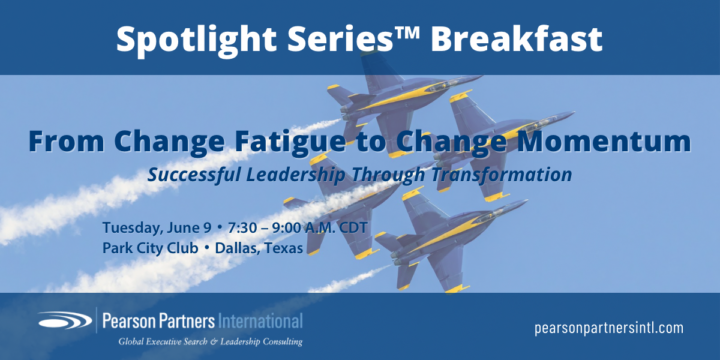
Pearson Partners International’s Q2 2026 Spotlight Series™️ Breakfast on June 9 convened a panel of business leaders with extensive experience leading transformations across technology, consumer businesses, and global organizations.
The panelists described transformations they had each led, including consolidating dozens of legacy systems, integrating acquisitions, rescuing an organization approaching bankruptcy, and reducing hundreds of annual technology outages.
Throughout the discussion, a common theme emerged:
Successful transformation begins by connecting the business case with the human one.
Start With the “Why”
Transformation often begins at the top, with a compelling business rationale such as improving profitability, modernizing systems, integrating an acquisition, accelerating growth, or addressing a competitive threat.
For a board, the rationale for change might be financial performance or risk reduction. For an operations team, it might mean fewer disruptions. But for an employee working nights and weekends to keep unstable systems functioning, success might mean something much more personal: reducing stress and getting their weekends back.
Employees experience transformation differently. They want to understand why the change matters, how it will affect their daily work, what the organization will look like when the transformation succeeds, and whether the effort is producing tangible results. Leaders who do not answer those questions risk creating compliance (at best) instead of commitment.
Even a strategically sound transformation can lose momentum amid continual uncertainty, inconsistent communication, or unclear benefits. Leaders, therefore, need to communicate the “why” in ways that resonate with different groups across the organization. The strategic rationale should remain consistent, but leadership must translate its relevance for the people they are asking to execute it.
As one panelist observed, transformation succeeds when leaders connect “hearts and minds” rather than simply announce plans.
Listen Before You Lead
Several of the panelists’ business transformations began with what one described as a “listening tour.” One entered an organization expecting to primarily accelerate growth. However, after visiting locations, speaking with managers, and listening to employees, he discovered that the organization first needed to address foundational issues.
That process changed the leader’s message from “Here is what I am going to do” to “Here is what you told us, and this is what we are going to do about it.”
In that way, employees perceive transformation as something they helped shape rather than something imposed upon them.
The panelists suggested a four-step framework for how to manage transformation:
- Clarify. Establish who the organization is, where it is going, and what it is trying to accomplish.
- Simplify. Remove unnecessary complexity and competing demands.
- Innovate. Introduce innovative ideas after the organization has sufficient clarity and capacity to absorb them.
- Execute. Give people the tools and environment necessary to deliver.
The sequence is important. Leaders are often drawn to innovation. However, introducing more initiatives into an already overloaded organization can intensify the very fatigue leadership is trying to overcome.
Build Momentum Through Visible Wins
Large transformations can take years. That creates a fundamental leadership challenge: How do you sustain energy when the outcome is far in the future?
One panelist compared the process to distance running. Runners do not wait until the finish line to refuel. They replenish energy throughout the race. Transformation teams need the organizational equivalent. That means deliberately creating and recognizing incremental wins.
Another panelist gave an example of a technology transformation that had already run years behind schedule. Rather than simply asking an exhausted team to work harder toward a distant objective, leadership set achievable goalposts and consistently communicated progress.
People are more willing to tolerate disruption when they can see evidence that their effort is producing results.
Moreover, leaders should think broadly about what constitutes a win. If certain failures are outside the organization’s control, reducing the failures it can control is progress. For example, if system outages cannot be eliminated immediately, reducing their duration is progress. If an overworked team can reclaim a holiday weekend with family, that can be a meaningful measure of progress as well.
Leaders who wait until the transformation is complete to celebrate may discover that their people have run out of energy long before the finish line.
Match Actions to Intentions
As the panelists emphasized, communication is essential during transformation, but communication alone does not create buy-in. Authenticity is crucial during a transformation, and leaders’ actions and intentions must align.
Employees notice when leaders’ actions do not match their words, particularly during times of uncertainty. As one panelist noted, people can quickly see through a carefully crafted transformation message when an organization’s decisions, investments, and incentives tell a different story.
For example, if executives describe a transformation as an investment in customers and employees, while every visible decision appears focused exclusively on cost reduction, people notice the contradiction. If leaders encourage experimentation but punish every unsuccessful attempt, employees learn that experimentation is not actually safe.
Leaders also need to create room for setbacks. Transformation rarely goes exactly according to plan. Recognizing what did not work, learning from it, and adjusting course can strengthen credibility. The goal is not to manufacture the appearance of uninterrupted success but rather to show progress, acknowledge problems, and respond to what the organization is learning.
Give People Ownership of the Change
One of the discussion’s most memorable examples of a change initiative involved something deceptively simple: complimentary bread.
A large restaurant brand had discontinued a longstanding complimentary bread offering during the pandemic. The operational rationale initially made sense, and it saved money. But customers continued asking for something they associated strongly with the brand.
A new leader believed it should return. Simply issuing a directive, however, would have created another top-down operational demand for already busy restaurant teams. Instead, the organization listened to employees and customers and shared what they were hearing. The case for bringing back the bread began to come from the people closest to the customer.
By the time it returned, employees did not perceive it as simply the new CEO’s idea. They understood why it mattered and could see the connection to the customer experience and the identity of the brand. This buy-in illustrated a crucial point:
People support what they help create.
Leaders do not surrender decision-making authority by inviting participation. Rather, they improve the quality of the decision while building the team commitment required to execute it.
Build Trust with the Board One Commitment at a Time
Transformation fatigue is not limited to employees. Boards that have watched previous initiatives miss deadlines, exceed budgets, or fail to produce promised results can become skeptical of the next transformation plan. A sophisticated presentation alone will not restore confidence without execution.
One panelist described entering an organization where board members had repeatedly heard ambitious transformation strategies without seeing corresponding results. Rather than asking the board to immediately embrace another multiyear vision, the executive paired the long-term strategy with specific quarterly commitments.
After two quarters of demonstrated progress, the board conversation changed. Instead of questioning whether immediate milestones would be achieved, directors began asking about outcomes further into the future. This trust created strategic breathing room.
Another panelist described a similar experience after inheriting a technology project that was already years overdue. Regular progress reports, consistent execution, and transparent communication gradually built credibility with the board.
The panelists’ lessons were straightforward:
Say what you are going to do, do it, and repeat.
For leaders, that discipline is more persuasive than any transformation deck.
Create Organizational Stamina
Transformation also raises a longer-term question: How can organizations develop the stamina to navigate continuous change when employee tenure is declining, and critical institutional knowledge can disappear quickly?
One answer is to stop thinking about employees solely in terms of the positions they currently hold. A panelist recalled an organization where long-tenured employees remained engaged by moving through a variety of functions and responsibilities over the course of their careers. Rather than viewing people as permanently belonging in finance, technology, or operations, leaders looked more broadly at individuals’ capabilities and potential, creating opportunities to move into different roles and functions.
This approach can simultaneously strengthen retention, leadership development, and organizational resilience. People are more likely to remain where they feel they belong, where they continue to learn, and where they can envision opportunities beyond their current role.
Successful leaders recognize what people do well and create opportunities that allow those strengths to develop. Not every talented employee belongs on the same career path. Organizational stamina depends on matching people with work in which they can contribute, grow, and see a future.
AI is a Transformation Challenge, but Still a Human One
No contemporary conversation about business transformation is complete without mentioning artificial intelligence. Yet the panel cautioned against treating AI as fundamentally different from previous technology transformations.
AI is an extraordinarily powerful capability, but technology itself does not eliminate the need for judgment, leadership, or organizational change. In fact, the speed of AI adoption makes the human element even more important.
Instead of asking, “How do we put AI on top of what we already do?” boards and executives should consider how AI can benefit the organization and what employees need to work effectively in that environment.
That approach requires investment in education, skill development, and critical thinking. As organizations determine where AI can add value, they also need to consider the experience and institutional knowledge employees bring to the work.
One panelist described AI as an “always-on assistant.” That makes human judgment even more important. Employees must know when to use the technology, how to evaluate its output, and when to override it with experience and critical thinking.
Organizations that focus exclusively on the time and cost savings associated with AI may therefore miss the larger transformation opportunity:
The greater AI opportunity lies in effectively combining technology capabilities with human experience and judgment.
From Change Fatigue to Change Momentum
During the event’s Q&A session, an audience member posed a revealing question to the panel: If they could have the exact same professional environment five years from now that they have today, would they choose it? All three panelists said yes.
He then posed a similar question to the audience: Would they want to stay exactly where they were for five years? Their answer was a resounding no.
This response made the paradox of change fatigue clear: People can be exhausted by change and still not want a future without it.
The goal, of course, is not to eliminate change. In a business environment shaped by technological disruption, shifting markets, and continual uncertainty, avoiding change is neither realistic nor desirable. The leadership challenge is to make transformation worth the effort.
That means listening before prescribing, giving people a compelling reason for the change, simplifying competing priorities, translating strategy into individual relevance, and making progress visible. It also means celebrating incremental wins before the finish line, acknowledging setbacks honestly, and ensuring that leadership’s behavior aligns with its message.
Transformation requires recognizing that people are not simply resources in a change-management plan. They are the mechanism through which transformation happens.
Employees are most likely to embrace change when they understand why it matters, see where they fit, and know that their work is valued and moving the organization forward. In that way, change fatigue becomes change momentum.
Pearson Partners International helps executives and organizations navigate complex dynamics through our quarterly Spotlight Series™ events—continuing the conversation on leadership, strategy and the future of work.
Learn more about the Pearson Partners Spotlight Series™ breakfast events.
Related Posts







- ← Making the Big Bets at UT Dallas
- Can North Texas Infrastructure Keep Pace with the Region’s Growth? →


